 あなたのウェブサイト名
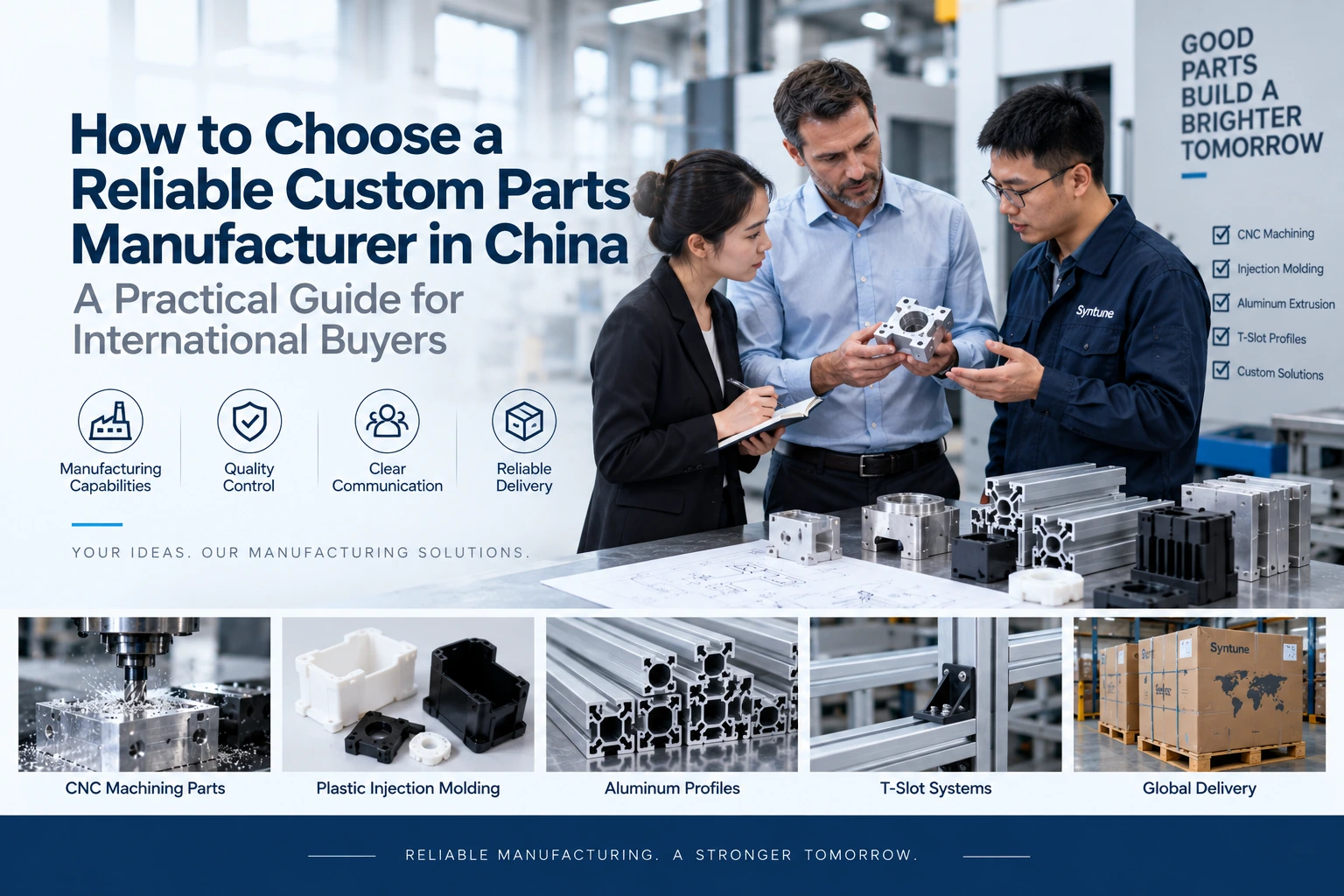
How to Choose a Reliable Custom Parts Manufacturer in China
China remains an important sourcing destination for custom industrial components, including CNC machined parts, injection molded plastic parts, aluminum profiles, and modular framing components.
For international buyers, however, finding a supplier is usually not the difficult part.
The real challenge is finding a supplier that can consistently manufacture parts according to drawings, control quality, communicate clearly, and support repeat orders.
A low quotation alone does not tell you whether a supplier is suitable for your project.
Before placing an order, buyers should evaluate technical capabilities, quality control, communication, production capacity, lead times, and export experience.
Here are some of the most important factors to consider when choosing a custom parts manufacturer in China.
1. Start With Manufacturing Capabilities
The first question should be simple:
Can the supplier actually manufacture your part correctly?
Different custom components require different processes.
A supplier may specialize in CNC machining but have limited experience with extrusion or injection molding. Another may provide multiple processes but outsource some operations.
Depending on your project, manufacturing capabilities may include:
- CNC milling
- CNC turning
- Aluminum extrusion
- Plastic injection molding
- Drilling and tapping
- Cutting
- Surface finishing
- Assembly
- Inspection
Do not evaluate capability only from a list of machines.
The supplier should also understand the materials, tolerances, geometries, and production requirements involved in your specific component.
2. Send Technical Drawings, Not Just Photos
A product photograph is useful for understanding appearance, but it is rarely enough for an accurate custom manufacturing quotation.
For precision components, provide technical information whenever possible.
A complete RFQ may include:
- 2D drawings
- 3D CAD files
- Material specifications
- Dimensional tolerances
- Surface finish
- Required quantity
- Expected annual volume
- Inspection requirements
- Packaging requirements
STEP files are particularly useful for understanding three-dimensional geometry, while 2D drawings can identify critical tolerances, threads, finishes, and other specifications.
The quality of the supplier’s response to your drawings can also tell you a lot about its technical understanding.
3. Evaluate Their Engineering Communication
Communication in custom manufacturing is not simply about receiving fast email replies.
A good supplier should be able to identify unclear or potentially problematic specifications before production.
For example, they may ask questions about:
- An unusually tight tolerance
- An unspecified material grade
- A difficult-to-machine feature
- A wall thickness that may cause molding problems
- An extrusion geometry that could be difficult to produce
- Missing surface treatment requirements
These questions are not necessarily a problem.
In many cases, they indicate that the supplier is actually reviewing the project rather than simply quoting a price.
For international projects, clear technical communication can prevent costly mistakes later.
4. Ask About Quality Control
Quality control should be discussed before the purchase order, not after defective parts arrive.
The appropriate inspection method depends on the product.
Common inspection equipment and methods may include:
- Calipers
- Micrometers
- Height gauges
- Thread gauges
- Surface inspection
- Dimensional inspection
- Coordinate measuring equipment when required
For critical components, buyers should clearly identify which dimensions or characteristics require special attention.
You may also ask whether inspection reports, material documentation, or other quality records can be provided when required.
The objective is not to demand unnecessary paperwork for every component.
It is to make sure that the quality-control process matches the actual risk of the project.
5. Do Not Automatically Choose the Lowest Quote
Price matters, particularly for repeat production.
But the lowest quotation can become expensive if it leads to dimensional problems, inconsistent batches, delayed shipments, or unusable components.
When comparing quotations, check whether each supplier is quoting the same requirements.
For example:
Material: Is the specified grade the same?
Surface treatment: Is it included?
Tooling: Is mold or extrusion die cost included separately?
Inspection: Are special inspection requirements included?
Packaging: Is export packaging included?
Shipping: Is freight included or excluded?
A quotation that initially appears more expensive may actually include more of the required work.
Compare the complete scope rather than only the final number.
6. Understand Tooling Ownership and Costs
Tooling is particularly important for plastic injection molding and custom aluminum extrusion.
Before paying for tooling, clarify:
- Tooling cost
- Expected tool life
- Sample or trial process
- Modification policy
- Tooling ownership
- Storage arrangements
- Replacement conditions
For CNC machining projects, dedicated molds or extrusion dies may not be necessary, but fixtures or special tooling may still affect the quotation.
Understanding these costs in advance makes future repeat orders easier to manage.
7. Use Samples or First Articles for New Projects
For a new custom component, moving directly into a large production order can create unnecessary risk.
When practical, request prototypes, samples, or first-article parts before mass production.
Check:
- Dimensions
- Assembly fit
- Material
- Surface appearance
- Functional performance
- Critical tolerances
For injection molding and extrusion projects, samples produced from new tooling are particularly important because they allow the tooling and finished component to be evaluated before full production begins.
A clear sample approval process protects both the buyer and supplier.
8. Ask About Production Lead Time
Lead time should be evaluated realistically.
Custom manufacturing often includes several stages.
For example, an aluminum extrusion project may require:
Drawing review → Die manufacturing → Trial extrusion → Sample inspection → Surface treatment → Machining → Final inspection → Packing
An injection molding project may involve mold design and mold trials before production begins.
CNC machining may have a shorter setup process, but lead time still depends on material availability, machining complexity, quantity, finishing, and factory capacity.
Instead of asking only:
“How many days?”
Ask what stages are included in the quoted lead time.
This provides a much clearer picture of the project schedule.
9. Consider Secondary Processing
Many industrial components require more than one manufacturing process.
An aluminum profile, for example, may require extrusion followed by:
- Precision cutting
- CNC machining
- Drilling
- Tapping
- Anodizing
- Assembly
Similarly, a CNC machined component may require plating, anodizing, polishing, or other finishing.
A supplier that can coordinate the required secondary processes may simplify sourcing and reduce the number of vendors involved in the project.
However, buyers should still confirm which operations are performed directly and which are managed through partner facilities when this information is important to the project.
10. Check Packaging and International Shipping Experience
A component can leave the factory in perfect condition and still arrive damaged if packaging is inadequate.
This is particularly important for:
- Long aluminum profiles
- Cosmetic surfaces
- Anodized components
- Precision machined parts
- Plastic parts susceptible to scratching
- Heavy industrial components
Discuss packaging before shipment.
Depending on the product, packaging may include protective film, individual wrapping, cartons, foam, wooden cases, pallets, or other export packaging.
International buyers should also confirm available shipping methods.
Common options include express delivery, air freight, sea freight, or shipment through the buyer’s nominated freight forwarder.
11. Evaluate the Supplier for Repeat Orders
A successful first order is important, but B2B sourcing usually involves a longer-term relationship.
Consider whether the supplier can maintain:
- Consistent materials
- Stable dimensions
- Surface finish consistency
- Drawing revisions
- Repeat-order specifications
- Reliable communication
Drawing revision control is especially important.
If a component changes from Version A to Version B, the manufacturer must clearly identify which revision should be used for the next production batch.
This becomes increasingly important as the number of custom parts grows.
A Practical Supplier Evaluation Checklist
Before selecting a custom parts supplier, ask yourself:
Technical capability
Can they manufacture the required geometry and material?
Drawing understanding
Do they understand the specifications and ask relevant technical questions?
Quality control
Can they inspect the critical characteristics?
Samples
Can the product be verified before mass production?
Lead time
Is the production schedule realistic and clearly explained?
Cost transparency
Are tooling, finishing, packaging, and other costs clearly identified?
Communication
Are technical questions handled accurately?
Export support
Can the products be packed and shipped appropriately for international orders?
If several of these areas remain unclear, additional evaluation may be necessary before placing a large order.
Sourcing Custom Parts From China
Successful sourcing is not simply about finding the lowest-cost factory.
For custom industrial components, the objective is to find a manufacturing solution that balances quality, cost, lead time, technical capability, and communication.
At Shenyang Syntune International Trade Co., 株式会社., we support international customers sourcing CNC machined parts, custom injection molded plastic parts, aluminum profiles, T-slot profiles, and related industrial components.
Projects can be evaluated according to customer drawings, materials, quantities, tolerances, surface requirements, and application needs.
If you are currently developing or sourcing a custom component, send us your 2D drawings, 3D files, material requirements, quantity, and technical specifications for evaluation.
Contact us to discuss your project and request a quotation.