 Your Website Name
CNC Machining vs. Aluminum Extrusion: Which Process Is Right for Your Parts?
When developing a custom aluminum component, choosing the right manufacturing process can have a significant impact on cost, lead time, dimensional accuracy, and production efficiency.
Two common manufacturing methods are CNC machining and aluminum extrusion.
Both processes can produce high-quality aluminum components, but they work in very different ways.
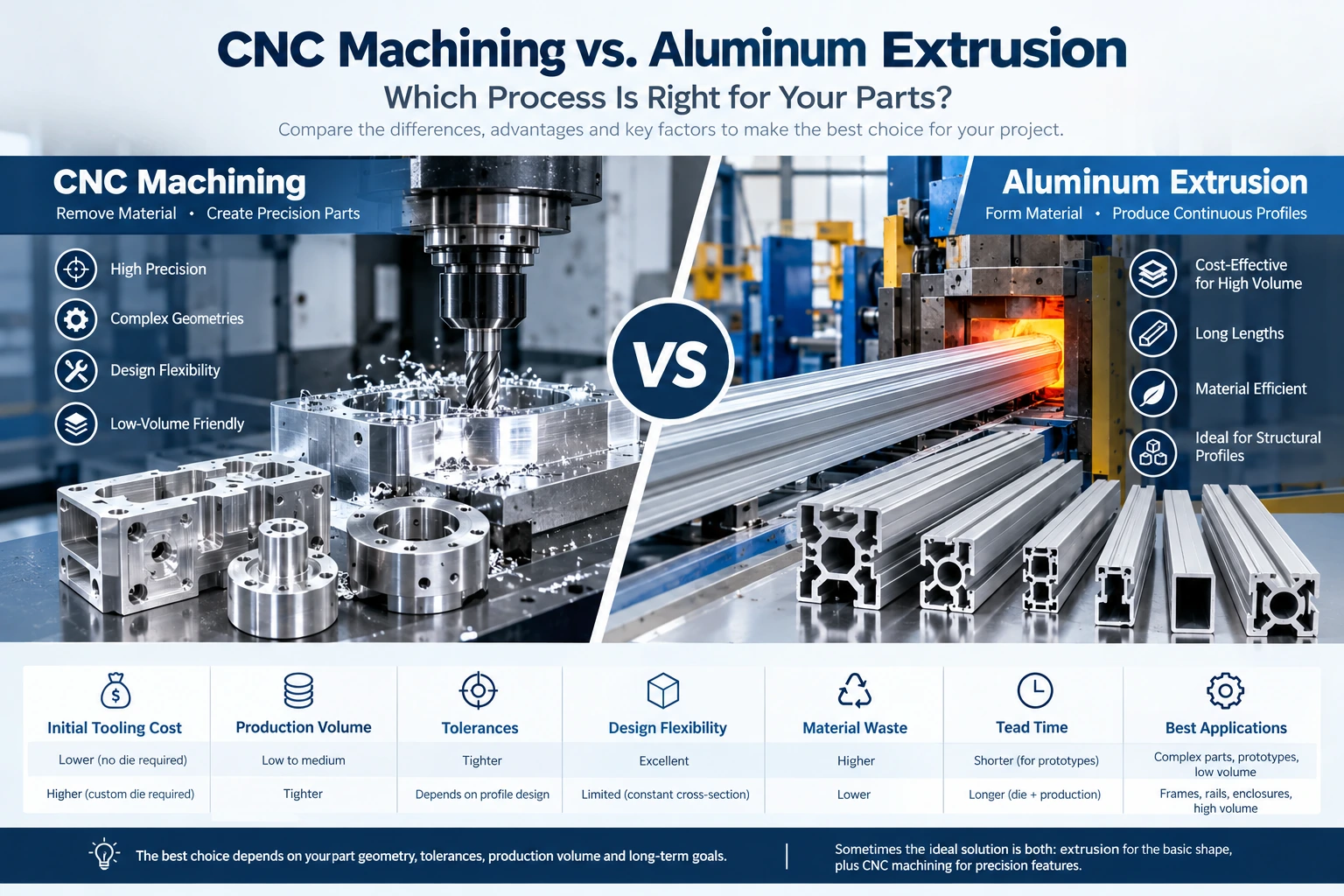
CNC machining removes material from a solid workpiece to create the required geometry. Aluminum extrusion forms heated aluminum through a die to create a continuous profile with a consistent cross-section.
Neither process is universally better than the other.
The right choice depends on your part geometry, tolerance requirements, production quantity, tooling budget, and long-term purchasing plan.
This guide compares CNC machining and aluminum extrusion to help buyers determine which process may be more suitable for their project.
What Is CNC Machining?
CNC machining is a subtractive manufacturing process.
A component typically begins as a block, plate, bar, or other piece of raw material. Computer-controlled cutting tools then remove material until the required shape is produced.
Common CNC operations include:
- Milling
- Turning
- Drilling
- Boring
- Tapping
- Threading
Because the cutting tool can create features in multiple directions, CNC machining provides considerable design flexibility.
It is commonly used for prototypes, precision mechanical parts, equipment components, housings, fixtures, and customized industrial parts.
What Is Aluminum Extrusion?
Aluminum extrusion is a forming process.
An aluminum billet is heated and forced through a die containing a specific cross-sectional shape.
The material exits the die as a continuous profile and can then be cut to the required length.
Extruded profiles can also undergo secondary operations such as:
- Cutting
- Drilling
- CNC milling
- Tapping
- Anodizing
- Powder coating
Extrusion is particularly efficient when a component has the same basic cross-section throughout its length.
Common applications include structural profiles, machine frames, enclosures, rails, architectural systems, pergola components, and T-slot framing.
The Main Difference: Removing Material vs. Forming Material
The fundamental difference between the two processes is how the part is created.
CNC machining achieves the final geometry by removing material.
Aluminum extrusion creates the primary geometry by forming material through a die.
Consider a long aluminum component containing several channels along its entire length.
Producing the channels by machining them from a solid block could require significant machining time and remove a large amount of aluminum.
If thousands of identical parts are required, creating those channels directly during extrusion may be more efficient.
However, if only ten highly complex components are required, manufacturing a dedicated extrusion die may not make economic sense.
In that situation, CNC machining may be the more practical choice.
Which Process Offers Greater Design Flexibility?
For individual part geometry, CNC machining generally provides greater flexibility.
It can create:
- Pockets
- Holes
- Threads
- Different surface levels
- Complex contours
- Precision mounting features
- Features on multiple sides
The design is not restricted to one continuous cross-section.
Aluminum extrusion, however, is primarily designed around a constant cross-sectional shape.
This limitation can also be an advantage.
A well-designed extrusion can integrate multiple functional features into one profile, potentially replacing several separate components.
For example, mounting channels, structural ribs, screw locations, and connection features can sometimes all be incorporated into one extrusion.
Which Process Provides Better Tolerances?
CNC machining is generally the better choice when very tight dimensional tolerances are required.
Because material is removed using precision cutting equipment, critical surfaces, holes, and mating features can be controlled accurately.
Extrusion tolerances are influenced by factors such as:
- Profile size
- Wall thickness
- Cross-sectional geometry
- Aluminum alloy
- Die design
- Straightness
- Cooling behavior
This does not mean extruded profiles cannot be used in precision assemblies.
Instead, many manufacturers combine the two processes.
The extrusion creates the overall geometry efficiently, while CNC machining is used afterward for critical features.
CNC Machining vs. Extrusion for Low-Volume Orders
For prototypes and low-volume orders, CNC machining often has an advantage because it normally does not require a dedicated extrusion die.
Once the CAD model and machining program are prepared, parts can be produced directly from available material.
This makes CNC machining particularly useful during product development.
If a design is still changing, modifying the CNC program is generally easier than changing an extrusion die.
For this reason, companies may use CNC machining during the prototype stage even when extrusion is planned for later mass production.
Which Is Better for High-Volume Production?
As production volume increases, aluminum extrusion can become more attractive for suitable part geometries.
The initial project requires tooling, but once the die has been completed and approved, long lengths of the required cross-section can be produced efficiently.
This can reduce:
- Machining time
- Material waste
- Unit cost
- Number of separate components
The economic advantage depends on the profile geometry and order quantity.
A custom extrusion does not automatically become cheaper simply because the order is large. Tooling, material usage, secondary machining, finishing, and logistics must all be considered.
What About Material Waste?
CNC machining can generate a significant amount of chips when a complex part is produced from a large solid block.
For certain geometries, much of the original material may be removed.
Extrusion can be more material-efficient when the required component has a consistent cross-section.
Instead of machining away large areas of material, the profile is formed much closer to its final geometry.
This is particularly useful for long structural components.
However, CNC machining remains highly efficient for components where extrusion cannot create the required three-dimensional geometry.
Comparing Tooling Costs
Tooling is another important difference.
CNC machining usually requires cutting tools, fixtures, and programming, but a dedicated forming die is generally not required for every custom component.
Custom aluminum extrusion normally requires an extrusion die.
This means extrusion typically involves a higher initial tooling commitment.
Buyers should therefore consider both:
Initial cost – How much is required to start production?
Long-term cost – What will the component cost over its expected production volume?
For a small order, avoiding tooling may be more important.
For a repeat product with substantial annual demand, investing in extrusion tooling may reduce long-term manufacturing costs.
When Should You Choose CNC Machining?
CNC machining may be a suitable choice when:
- Production quantities are relatively low
- The design may still change
- Tight tolerances are required
- The component has complex 3D geometry
- Multiple surfaces require machining
- Dedicated extrusion tooling is not economical
- Fast prototyping is important
It is also suitable for parts that simply cannot be produced through a constant extrusion cross-section.
When Should You Choose Aluminum Extrusion?
Aluminum extrusion may be appropriate when:
- The component has a consistent cross-section
- Longer profile lengths are required
- Production quantities justify tooling
- Material efficiency is important
- Structural channels or grooves can be integrated into the design
- Repeat production is expected
Extrusion is particularly useful for frames, rails, structural components, enclosures, and modular systems.
Sometimes the Best Solution Is Both
CNC machining and aluminum extrusion should not always be viewed as competing processes.
For many industrial components, the most efficient manufacturing strategy is actually:
Aluminum Extrusion + CNC Machining
The extrusion produces the basic cross-sectional geometry.
The profile is then cut to length and CNC machined to add precision features such as:
- Mounting holes
- Threads
- Slots
- Pockets
- End features
- Precision interfaces
Surface treatment can then be applied according to the project requirements.
This approach can combine the material efficiency of extrusion with the dimensional flexibility of CNC machining.
Quick Comparison
| Factor | CNC Machining | Aluminum Extrusion |
|---|---|---|
| Initial tooling | Usually lower | Custom die normally required |
| Low-volume production | Excellent | Less economical for custom profiles |
| High-volume potential | Good | Excellent for suitable designs |
| Complex 3D geometry | Excellent | Limited |
| Constant cross-section | Possible, but may waste material | Excellent |
| Tight tolerances | Excellent | Depends on profile design |
| Design changes | Relatively easy | May require die modification |
| Long components | Can become expensive | Highly suitable |
| Secondary machining | Main process | Often added after extrusion |
What Information Should You Provide to a Supplier?
If you are unsure which manufacturing process is appropriate, provide as much technical information as possible.
Useful information includes:
- 2D drawings
- 3D CAD files
- Aluminum alloy
- Critical tolerances
- Required surface finish
- Order quantity
- Estimated annual volume
- Intended application
A supplier can then evaluate whether CNC machining, extrusion, or a combination of both is more practical.
Finding the Right Manufacturing Solution
Manufacturing decisions should be based on the complete project rather than one individual factor.
A process with a lower initial cost may not provide the best unit cost for long-term production. Similarly, investing in custom tooling may not make sense when quantities are small or the design is still evolving.
At Shenyang Syntune International Trade Co., Ltd., we support both custom CNC machined parts and aluminum profile solutions, allowing projects to be evaluated according to geometry, quantity, precision, and application requirements.
For components requiring both extrusion and secondary machining, the manufacturing steps can be considered together rather than independently.
Send us your drawings, quantity, material, and technical requirements to discuss a suitable manufacturing solution for your project.